
Emergency AC Repair & Installation Near Me: What Winchester Homeowners Should Do First
When the temperature in Winchester climbs past 100°F, a failed air conditioner turns a house into an oven faster than most people expect. The interior can reach dangerous heat within about four hours. And the panic that sets in during those first thirty minutes is exactly what opportunistic contractors count on. This guide walks you through the specific steps that keep you in control before any technician pulls into your driveway, so you pay a fair price for a quick fix instead of an inflated one for a rushed job.
If you’d rather skip the checklist and get a qualified person on the line, call (844) 783-5043. A live person answers, day or night.
What should you do in the first thirty minutes after your AC fails in Winchester?
The first move after a summer breakdown is to slow the heat gain, not to start tearing panels off the unit. Four steps actually work. Several popular ones don’t.
What works:
- Close every window and exterior door, and pull the blinds on sun-facing walls. In Winchester’s dry desert climate, direct sun through west-facing glass adds serious heat load by mid-afternoon. Blocking it is the single fastest move you can make.
- Run ceiling fans and box fans to move air, not to cool it. Fans don’t lower the temperature, but moving air helps your body shed heat. Point one fan out an open window to pull hot air out of the hottest room.
- Move everyone to the lowest floor and the most shaded side of the house. Heat rises, and the north side of a Winchester home runs noticeably cooler than the west side in July.
- Fill the bathtub with cool water before you do anything else if anyone in the house is elderly or very young. Cooling centers and cold compresses beat waiting for a callback.
What is mostly myth: opening every window at once when outdoor air is 105°F just lets hot air in. Hanging wet sheets in front of box fans helps a little in a dry climate but does nothing when humidity spikes during monsoon season. Cracking the freezer open to “cool the kitchen” wastes energy and spoils food faster.
How do you read your thermostat, breaker panel, and outdoor unit before calling?
A dispatcher who knows what your system is doing sends a better-prepared technician and often narrows the problem before the truck leaves. Here’s what to look at, and what each reading tells the person on the phone.
Thermostat: Check that it’s set to COOL, not FAN or OFF, and that the setpoint is at least three degrees below the current room temperature. A blank screen usually means a tripped breaker or dead batteries, not a dead system. Note the exact reading. In our experience, “the screen was blank and it came back on after I reset the breaker” tells us far more than “the AC stopped working.”
Breaker panel: Find the two-pole breaker labeled for the AC (usually the biggest one in the panel, often 30 or 40 amps). If it’s tripped, it will sit halfway between ON and OFF. Don’t just flip it. Look at whether it looks scorched or smells hot. That detail matters. A breaker that trips once on a 110°F afternoon is a different call than one that trips twice in an hour.
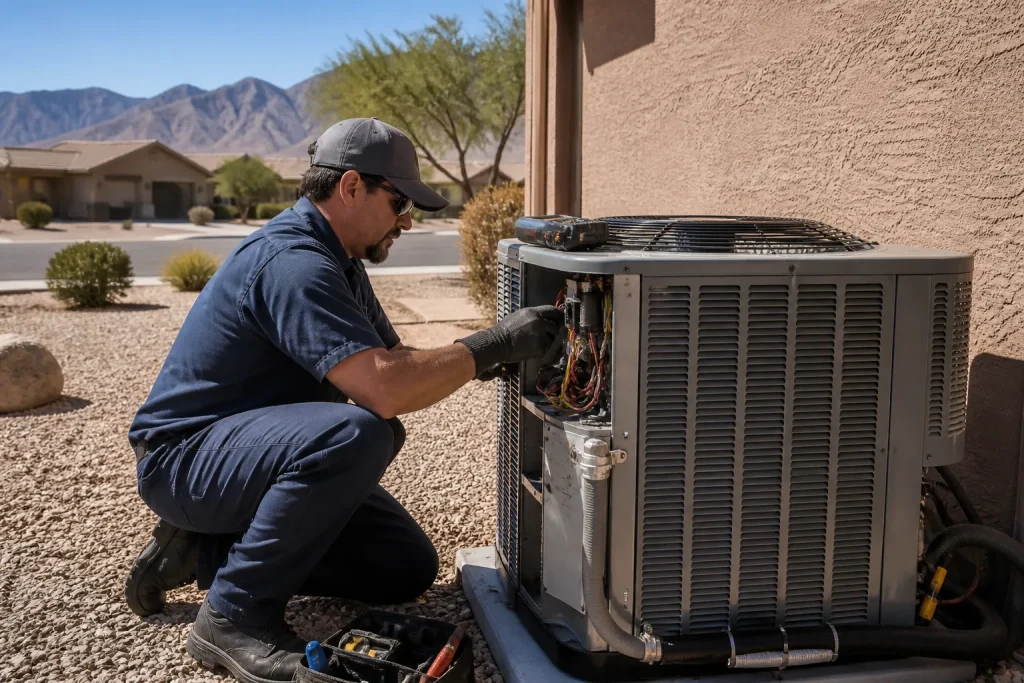
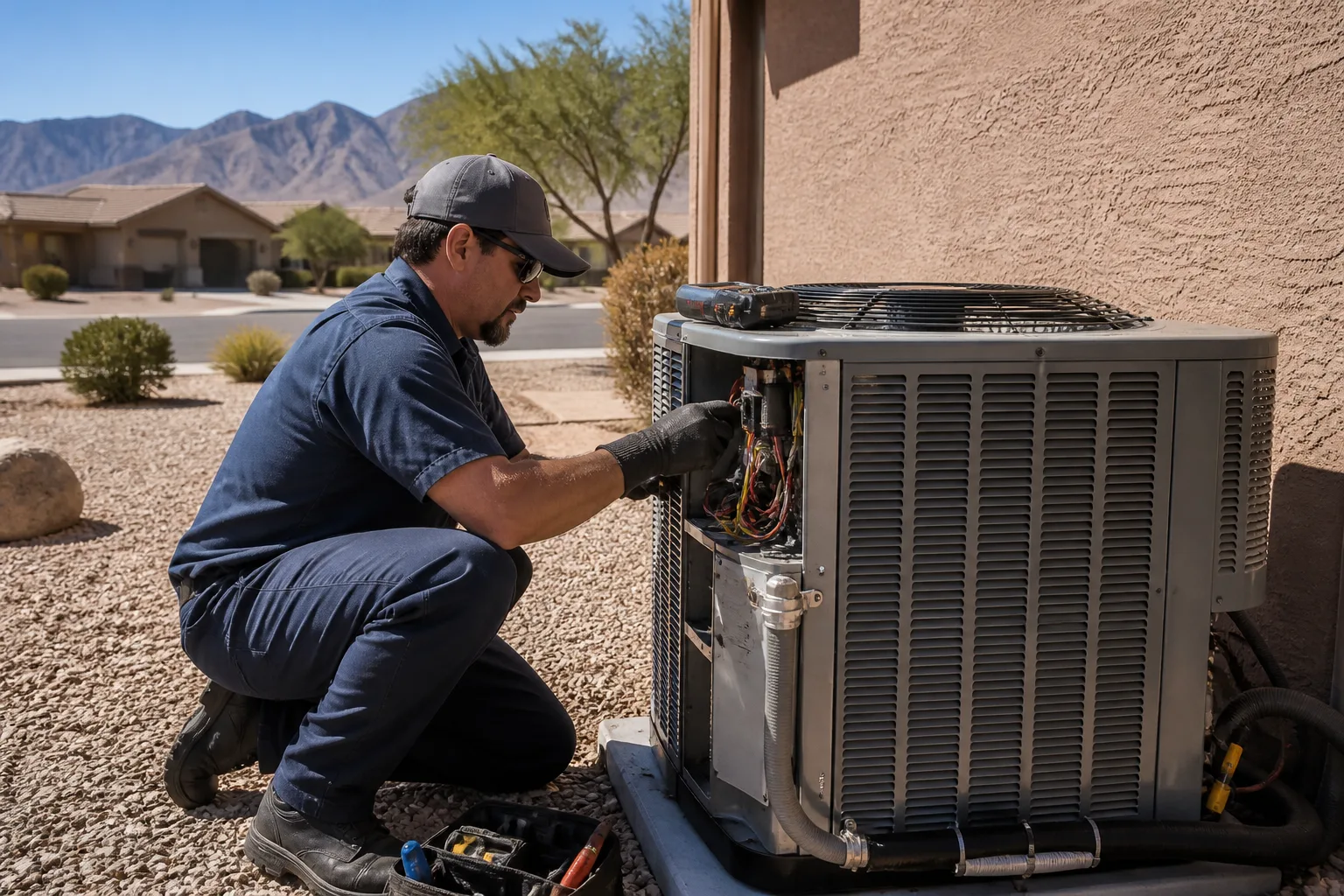
Outdoor unit: Look at the big condenser in the side yard. Is the fan spinning? Is the copper line between the house and the unit cold and sweating, or just cool? Is there ice on the pipes? Is the unit clicking repeatedly? Is there a puddle around the base or an ice block at the drain line? Any of those answers changes the diagnosis. Carrier, Trane, and Lennox units all show these signs the same way, so the detail travels.
Write the model number and brand off the unit’s rating plate before you call. It lets the dispatcher confirm parts availability before a technician drives out.
Which “emergency” calls turn out to be a ten-minute fix?
A surprising share of emergency calls we run in Winchester resolve on the phone or in the first ten minutes at the door. That’s good news for your wallet, and it’s why the questions on the other end of the line matter.
- A tripped breaker. Happens most during Winchester heat waves when the system runs continuously for hours. Reset carefully once. If it trips again, stop and call.
- A clogged condensate drain line. The float switch shuts the system off when the pan fills. A wet spot near the indoor unit or an ice-cold filter usually points this way.
- A dirty air filter. If it’s been more than three months, swap it. Restricted airflow makes a system overheat and shut down on safety, especially on a 110°F day.
- A thermostat set to the wrong mode or a schedule left from last winter. Check the mode and the setpoint before assuming the worst.
- A battery-dead thermostat. Blank display, no fan, no compressor. Ten-second fix.
What is not a homeowner fix: a failed capacitor, a seized compressor, a refrigerant leak, or burned wiring at the contactor. Those need a trained technician and meter readings on the actual components. The distinction matters because a homeowner who has checked the obvious things gets a faster, more accurate answer when they call.
What questions should you ask before agreeing to an emergency dispatch in Winchester?
The questions you ask now separate a company worth trusting from one that inflates the price because it knows you’re desperate. Ask every one of them.
- “Is a real person answering, or am I leaving a message?” If a voicemail tree picks up at 11 p.m. in a Winchester heat wave, your AC may wait until morning. Fireside keeps a live person on the phone around the clock, every day of the year.
- “Is there a charge for after-hours or weekend dispatch, and what is the diagnostic fee?” A company that quotes you a number before it arrives, and stands behind it, is not the one to worry about.
- “Will you confirm the price before starting work?” The right answer is yes, upfront, in writing. No “we’ll see once we open it up.”
- “Can you tell me without coming out what signs point to a repair versus a replacement?” A good dispatcher will.
- “What happens if the fix doesn’t hold?” You want a guarantee in writing. Ours is the 90-Day Done Right Promise. If the repair isn’t right, we make it right, and there’s no arguing about it.
- “How long have your technicians been trained on my brand?” At Fireside, our technicians have up to 8 years of experience and are trained across nine major residential brands including Carrier, Trane, Lennox, and Goodman.
Answers that should raise a flag: pressure to sign a service contract before seeing the unit; a quoted price that keeps changing on the phone; a dispatcher who refuses to give a name or confirm a written diagnostic fee; and any company that promises a full system replacement can be done the same day. A proper install is load-calculated and scheduled, not improvised at 2 a.m.
What does a Fireside overnight call actually look like?
Here’s the behind-the-scenes answer, because very few companies are willing to spell it out.
When you call (844) 783-5043 at 2 a.m. on a July night in Winchester, a live person answers. No voicemail tree, no callback promise. The dispatcher asks four things: what’s the system doing right now (running, dead, tripping, icing), what the thermostat and outdoor unit look like, whether anyone in the home is elderly, very young, or medically fragile, and the brand and approximate age of the equipment.
On high-heat days, those calls get prioritized. Households with an infant, an elderly resident, or a medical need go first. Then calls where the system is completely down, then partial-cooling calls. That’s not a policy we invented. It’s the same triage any responsible emergency HVAC company runs on a 112°F afternoon in Clark County.
Every technician arrives background-checked, in a uniform, with shoe covers on before you ask. Most jobs are completed in a single visit, because we prepare for the appointment off the phone details. If it turns out to be a ten-minute fix, you pay for a service call, not for a story about a compressor.
The Bottom Line
Your AC failing in a Winchester heat wave is stressful, but the next thirty minutes are yours to control. Shut the windows and blinds, move the family to the coolest part of the house, then read the thermostat, breaker, and outdoor unit so you can give a dispatcher real information. Ask the questions above before you agree to dispatch, and trust the company that gives you a live person, a written price, and a guarantee in writing.
If you’re in Winchester and need help, Fireside Heating & Air Co. Winchester offers free estimates and honest dispatch. Call (844) 783-5043 any hour of the day or night. Standing offers include $50 Off Any Repair Over $250, a Free Second Opinion on Any Written Estimate, and a permanent Senior and Veteran 5% discount.
Related services in Winchester: For routine service and true emergency repair, see AC Repair & Installation in Winchester. For heating season, see Heating & Furnace in Winchester. For ductless and high-efficiency systems, see Heat Pump & Mini Split in Winchester. To learn more about who we are, visit the Fireside Heating & Air Co. Winchester home page.
Frequently Asked Questions
Most emergency AC repairs in Winchester run between $180 and $450, depending on the part (capacitor, contactor, blower motor, refrigerant charge) and the time of day. Diagnostic fees vary by company, so ask before dispatch. We quote the price before starting work. Call (844) 783-5043 for an exact quote; estimates are free.
Yes. Fireside answers the phone 24 hours a day, including weekends and holidays, and dispatches same-day on emergency calls across Winchester. If a household has an infant, an elderly resident, or a medical need, tell the dispatcher. Calls are prioritized accordingly. Call (844) 783-5043.
If the system is under 12 years old, the repair is under a third of replacement cost, and the unit has not needed multiple repairs in the last two years, repair is usually the right call. If it’s over 15 years old, uses R-22 refrigerant, or the compressor has failed, replacement with a properly sized Carrier, Trane, Lennox, or Daikin system is generally the more economical move. Call (844) 783-5043 and we’ll give you a straight answer either way, not a sales pitch.
Turn the system off at the thermostat and let the ice melt on its own before anyone touches it. Icing almost always signals low refrigerant or restricted airflow, which means a technician needs to measure pressures and check the metering device. Do not chip the ice off. You’ll damage the coil. Call (844) 783-5043 for a same-day visit; estimates are free.
Written by the team at Fireside Heating & Air Co. Winchester.
Need HVAC Help?
Call Fireside Heating & Air Co. Winchester - licensed & insured, here with fast after-hours help in Winchester.
(844) 783-5043